


The mention of Russia brings to mind an enormous territory. The nation extends across eleven time zones and two continents to become a massive and intricate entity. Russia exists as multiple worlds within a single world because it encompasses grand tsarist palaces alongside Soviet-era concrete structures and peaceful Lake Baikal and wild Siberian landscapes. The country’s historical events have determined global developments as its literary masterpieces and musical and artistic achievements remain permanently embedded in human heritage. The following guide provides an expedition into this vast territory. Pack your bags should not be your immediate response to this global situation. The invitation here invites readers to explore Russia through its historical imprint on Kremlin walls while discovering the artistic essence of Hermitage collections and the natural treasures that span its enormous territory. Our exploration starts in Moscow which remains the eternal heart of Russia throughout its centuries of existence.
The Heart of Power and History: Moscow (Москва)
Russia’s capital status does not fully capture the significance of Moscow because it serves as the central hub of political and historical power. The city presents vivid contrasts between medieval structures and contemporary high-rise buildings and between tsarist luxury and Soviet determination and post-Soviet commercialization. Knowledge of Moscow enables visitors to grasp the fundamental forces which have directed Russian history.
The Kremlin (Московский Кремль): A Fortress of Faith, Power, and Bloodshed
The term “Kremlin” has gained universal recognition as a Russian power symbol yet it represents a physical location above all else. The Kremlin functions as a large fortified area that contains a self-contained city space with red brick walls and 19 towers. Throughout many centuries this site served as the center where religious leaders and state administrators maintained their authority.
More Than a Single Building
A massive fortified complex known as the Kremlin contains multiple palaces and armories and most significantly houses a beautiful collection of cathedrals. The central Cathedral Square (Соборная площадь) stands as the historical centerpiece of the complex.
- Cathedral of the Dormition: This cathedral stands as the most important Russian church because of its five golden cupolas. The Tsars conducted elaborate coronation ceremonies at this location during many centuries.
- Cathedral of the Archangel: The Cathedral of the Archangel served as the final burial site for numerous Russian Tsars and Grand Princes during the period before the capital transitioned to St. Petersburg including Ivan the Terrible and the initial Romanov rulers. The building exterior features elaborate frescoes that depict the royal figures interred beneath its foundation.
The Armory and the Diamond Fund
The Kremlin walls harbor two of the world’s most breathtaking museums which reside inside its boundaries.
- The Armory Chamber (Оружейная палата) serves as a collection of weapons but it also contains more than weapons. The complex houses an incredible collection of decorative arts that belong to both Russian and European cultures. The collection includes state regalia, Fabergé eggs, royal carriages, and ceremonial vestments which demonstrate Russia’s vast diplomatic relationships and enormous wealth.
- The Diamond Fund (Алмазный фонд) operates as an independent exhibition space inside a secure facility which displays the royal jewels of the Russian Empire. The exhibition displays two remarkable diamonds: the Orlov Diamond which Catherine the Great received as a gift and the Shah Diamond. The exhibition showcases a direct and unadulterated display of imperial power and wealth.

Red Square (Красная площадь): The Stage of Russian History
Red Square stands directly east of the Kremlin’s walls as it ranks as the world’s most recognized public area. Red Square has witnessed every major event in Russian history from public declarations and executions to military parades and rock concerts. The title of this historic site leads to a fascinating although unknown story in history.
The Meaning of “Red”
The name Krasnaya Ploshchad has no connection to communism or the color of the bricks surrounding the square. In Old Russian, the word Красная (Krasnaya) meant “beautiful.” The square was thus originally named “Beautiful Square.” The association with “red” is a modern coincidence that was conveniently adopted during the Soviet era. This linguistic detail reveals a deeper, older layer of Russian culture.
St. Basil’s Cathedral (Собор Василия Блаженного): An Architectural Fantasia
The southern corner of the square features Russia’s most famous architectural landmark. St. Basil’s Cathedral presents itself as a mind-bending psychedelic work of art through its vibrant colors and intricate patterns and shapes. The onion domes of St. Basil’s Cathedral appear to defy all architectural principles because Ivan the Terrible commissioned this structure in the 16th century to celebrate his military triumph. According to a well-known (but probably false) story Ivan became so enchanted by the building’s beauty that he ordered the architects to be blinded to prevent them from creating another masterpiece.
A Square of Contrasts: Lenin and Luxury
The ideological conflict between different groups defines Red Square through its stone pavement.
- The granite structure of Lenin’s Mausoleum (Мавзолей Ленина) serves as a somber tomb that houses the embalmed body of the Soviet Union’s founder. The granite structure represents a powerful historical artifact from Russia’s communist period.
- The GUM (Главный универсальный магазин) department store stands directly across from the monument. The glass-roofed building from the Tsarist period now functions as a temple for international luxury brands. The opposing views between the communist monument and the capitalist palace reflect the ongoing identity crisis that Russia faces today.
The Moscow Metro (Московский метрополитен): Palaces for the People
The Moscow Metro system operates beneath the city streets to reveal its greatest artistic and architectural treasure. The Soviet government under Stalin built the Metro system to display Soviet power through its design of central stations which functioned as luxurious underground “palaces for the people.”
The Moscow Metro provides an artistic experience similar to visiting a gallery. The stations welcome visitors with marble walls and arches and mosaics and bronze statues and chandeliers that create a magnificent atmosphere.
The Moscow Metro is more than just a transportation system; it is a living museum of art, ideology, and architectural ambition, telling the story of 20th-century Russia from below.

The State Hermitage Museum (Госуда́рственный Эрмита́ж): A Universe of Art
It is impossible to discuss St. Petersburg without starting with the Hermitage. This is not merely a museum; it is one of the largest, oldest, and most significant art collections in the world, housed within a complex of historic buildings, including the magnificent Winter Palace (Зимний дворец), the former main residence of the Russian Tsars.
The Palace Itself: An Exhibit of Imperial Grandeur
Before you even see a single painting, the building itself is the main attraction. The sprawling green, white, and gold Winter Palace is a masterpiece of Elizabethan Baroque architecture. To walk through its halls is to walk through the height of imperial Russia’s wealth and power.
- The Jordan Staircase: The main diplomatic staircase of the palace is an overwhelming explosion of white marble, gold leaf, and elaborate stucco work, designed to awe and intimidate foreign ambassadors.
- The Malachite Room: A stunning drawing room featuring columns, urns, and paneling made from rich, green malachite, showcasing the incredible mineral wealth of the Urals.
The Collections: A Compendium of Human Creativity
The museum’s collection contains over three million items, though only a fraction are on display at any one time. The scope is staggering, from prehistoric artifacts to modern European art. While it’s impossible to summarize, its collections of Western European art are among the finest in the world, including:
- Masterpieces by Leonardo da Vinci (the Benois Madonna and the Litta Madonna), Rembrandt (including The Return of the Prodigal Son), Rubens, and Velázquez.
- An unparalleled collection of Impressionist and Post-Impressionist art, housed in the nearby General Staff Building, featuring iconic works by Monet, Renoir, Cézanne, Van Gogh, and a particularly strong collection of Matisse and Picasso.
A lesser-known, charming detail is the presence of the Hermitage cats. A lineage of felines has officially lived in the museum’s basement since the time of Empress Elizabeth, tasked with keeping the rodent population at bay. They are a beloved and enduring feature of the institution.

The Imperial Palaces: Retreats of Unimaginable Luxury
To fully grasp the scale of the Romanov dynasty’s wealth, one must venture outside the city center to their suburban summer residences. These are not mere houses; they are sprawling estates of fantasy and opulence.
Peterhof (Петерго́ф): The “Russian Versailles”
Located on the shore of the Gulf of Finland, the Peterhof Palace estate was Peter the Great’s direct answer to the Palace of Versailles in France. His goal was not just to match it, but to surpass it, particularly in the splendor of its water features.
The true masterpiece of Peterhof is the Grand Cascade. This enormous, terraced series of over 60 fountains flows from the base of the palace down to the sea canal. At its center is the iconic Samson Fountain, depicting the biblical hero prying open the jaws of a lion—a symbol of Russia’s victory over Sweden in the Great Northern War. The entire system is a marvel of 18th-century engineering, operating without the use of pumps, relying solely on gravity from reservoirs in the Upper Gardens. The moment the fountains are turned on each morning is a truly unforgettable spectacle of water, gold, and stone.
Catherine Palace (Екатерининский дворец): The Lost and Found Treasure
Located in the town of Tsarskoye Selo (now Pushkin), the Catherine Palace is a breathtaking example of Rococo architecture, with its impossibly long, sky-blue facade decorated with white and gold ornaments. While the entire palace is stunning, it is famous for one room above all others—a room whose story is one of the greatest mysteries of World War II.
The Amber Room (Янтарная комната)
The original Amber Room was a chamber decorated in panels of amber mosaic, backed with gold leaf and mirrors. A gift from the King of Prussia to Peter the Great in the 18th century, it was considered an “Eighth Wonder of the World.” In 1941, during the Nazi invasion, the room was dismantled by German soldiers and taken to Königsberg (now Kaliningrad), after which its trail goes cold. It vanished amidst the chaos of the end of the war and remains one of the world’s most sought-after lost treasures.
After decades of work, relying on old photographs and drawings, Russian artisans completed a painstaking reconstruction of the Amber Room, which opened to the public in 2003. To stand in this room today is to witness not only a masterpiece of Baroque art but also a testament to national pride and artistic resilience.
Symbols of the City: Faith, Revolution, and Literature
Back within the city limits, several key landmarks tell the story of St. Petersburg’s unique identity.
Church of the Savior on Spilled Blood (Спас на Крови)
This church is an immediate architectural shock. In a city of refined, Italian-inspired Neoclassical design, the Church on Spilled Blood is a riot of distinctly traditional Russian style, with vibrant, swirling onion domes that echo St. Basil’s in Moscow. Its name and location are deeply significant: it was built on the exact spot where Tsar Alexander II was assassinated in 1881. The interior is even more breathtaking than the exterior, with over 7,500 square meters of incredibly detailed mosaics covering nearly every surface, depicting biblical scenes with astonishing artistry.
Nevsky Prospekt (Не́вский проспе́кт)
This is the main artery and historical soul of St. Petersburg. The grand, 4.5-kilometer thoroughfare is lined with palaces, grand department stores, and historic churches. It is the setting for much of Russian literature, immortalized in the works of Gogol and Dostoevsky. To walk Nevsky Prospekt is to walk through the city’s history, crossing its iconic canals over elegant bridges like the Anichkov Bridge with its famous horse-tamer statues.
The Bronze Horseman (Медный всадник)
On the banks of the Neva River stands the city’s most powerful symbol: an iconic equestrian statue of its founder, Peter the Great. Commissioned by Catherine the Great, the statue depicts Peter as a heroic, forward-moving Roman hero, his horse rearing up on the edge of a cliff. Under its hooves, the horse tramples a snake, variously interpreted as representing Peter’s enemies, treason, or the obstacles he overcame to build his city. The statue is forever linked with Alexander Pushkin’s narrative poem of the same name, a cornerstone of Russian literature.
St. Petersburg is a city built on a colossal scale, a testament to one man’s vision and an empire’s ambition. It served as the glittering stage for the final, dramatic acts of the Russian Tsars and the crucible of the revolution that would change the world forever.
Lake Baikal (Озеро Байкал): The Pearl of Siberia
Deep in the heart of southern Siberia lies the region’s undisputed crown jewel: Lake Baikal. This is not just a lake; it is a natural wonder of planetary significance, a place of superlatives and ancient spirituality. Its crescent-shaped form, stretching for nearly 400 miles (636 km), holds a fifth of all the world’s unfrozen fresh water, more than all the North American Great Lakes combined.
A Lake of Superlatives
The statistics of Lake Baikal are staggering and essential to understanding its global importance:
- The World’s Oldest Lake: Baikal is estimated to be around 25-30 million years old, a geological elder that provides an unparalleled record of Earth’s history.
- The World’s Deepest Lake: It plunges to a depth of over a mile (1,642 meters or 5,387 feet).
- The World’s Clearest Lake: The water in Baikal is famously transparent, with visibility possible up to 130 feet (40 meters) in certain conditions.
- The “Galapagos of Russia”: Due to its ancient age and isolation, Baikal is home to an extraordinary level of biodiversity, with over 1,500 species of animals and 1,000 species of plants found nowhere else on Earth. The most famous endemic resident is the nerpa (нерпа), the world’s only exclusively freshwater seal.
The Two Faces of Baikal: Summer vs. Winter
Baikal offers two profoundly different, yet equally mesmerizing, experiences depending on the season.
- Summer Baikal: In summer, the lake is a vision of deep blue and turquoise water, set against the green hills of the surrounding taiga forest. The main hub for exploration is Olkhon Island (Ольхон), the largest of Baikal’s islands. It is a place of rugged beauty and the center of regional shamanism for the indigenous Buryat people. Shamanka Rock (Скала-Шаманка), near the main village of Khuzhir, is one of the most sacred places in Asia, a site of ancient rituals and powerful spiritual energy.
- Winter Baikal: In winter, the lake transforms into an otherworldly kingdom of ice. From roughly January to May, it freezes solid, creating ice so thick that vehicles can drive across its surface. This ice, known as led (лёд), is famously transparent due to the water’s purity. It is possible to see straight down into the dark depths for dozens of feet. The ice is famous for the massive shards of turquoise that get pushed up onto the surface and the intricate patterns of methane bubbles frozen in suspended animation just below your feet. The deep, booming, and cracking sounds of the shifting ice, echoing for miles across the frozen expanse, are a truly unforgettable natural phenomenon.

The Trans-Siberian Railway (Транссибирская магистраль): The Steel Ribbon Across a Continent
If Lake Baikal is Siberia’s natural soul, the Trans-Siberian Railway is its human-made backbone. It is not merely a train ride; it is one of the world’s truly epic journeys, a slow, rhythmic passage across a seventh of the Earth’s landmass. Stretching 5,772 miles (9,289 km) from Moscow to Vladivostok on the Pacific coast, it is the longest railway line in the world.
An Engineering Marvel of Imperial Ambition
Constructed between 1891 and 1916 under Tsars Alexander III and Nicholas II, the railway was a colossal feat of engineering and a powerful geopolitical statement. It was designed to unify the sprawling Russian Empire, transport troops to the east, and exploit the vast natural resources of Siberia. The construction was brutal, carried out by a workforce of laborers, soldiers, and convicts in some of the harshest conditions on the planet.
The Journey, Not the Destination
The true Trans-Siberian experience is found in the journey itself. It is a slow immersion into the scale of the country, where days are measured not by clocks but by the changing landscapes outside the window—from the forests of European Russia to the endless birch taiga of Siberia and the rolling steppes of the east. Life on the train has its own unique culture:
- The ritual of drinking hot tea from traditional glasses held in ornate metal holders called podstakannik (подстаканник).
- The social life that develops in the carriages, sharing food and stories with fellow travelers from all corners of Russia and the world.
- The central role of the provodnitsa (проводница), the formidable female carriage attendant who is the ultimate authority on board, in charge of everything from distributing linens to enforcing order.
Key Stops Along the Way: A Glimpse into Siberian Cities
The journey connects dozens of cities, each with its own character and history.
- Yekaterinburg (Екатеринбург): Located in the Ural Mountains, this city marks the geographical border between Europe and Asia. It is indelibly linked with one of the most tragic events in Russian history: the 1918 execution of Tsar Nicholas II and his family. The Church on Blood now stands on the site of their murder, a somber place of pilgrimage.
- Novosibirsk (Новосибирск): The largest city in Siberia and its unofficial capital. Founded as a hub for the railway, it grew into a major center of Soviet industry and science. It is home to Akademgorodok (“Academy Town”), a purpose-built center for scientific research, once a jewel of the Soviet academic system.
- Irkutsk (Иркутск): Often called the “Paris of Siberia,” Irkutsk is one of the region’s oldest and most beautiful cities. It served as a place of exile for many Russian artists, officers, and nobles, including those involved in the 1825 Decembrist revolt. As a result, the city developed a rich cultural and intellectual life. It is famous for its blocks of beautiful and ornate traditional wooden houses with intricate “wooden lace” carvings. Today, it serves as the primary gateway for travelers heading to Lake Baikal.
The Trans-Siberian Railway is more than a transportation route; it is a moving cross-section of Russia, a thread connecting its diverse peoples, histories, and immense, awe-inspiring landscapes.

The Kamchatka Peninsula (Полуостров Камчатка): The Land of Fire and Ice
In the Russian Far East, jutting out into the Pacific Ocean, lies the Kamchatka Peninsula. This is one of the most volcanically active regions on the planet, a place of raw, primordial, and largely untouched wilderness. It is a land still in the process of being born, shaped by colossal forces from deep within the Earth. With no road or rail connections to the rest of Russia, it is accessible only by air or sea, making it one of the most remote and pristine destinations on Earth.
Russia’s Pacific Ring of Fire
Kamchatka is home to over 300 volcanoes, with around 30 of them still active. This incredible concentration of volcanic activity creates landscapes that are both breathtakingly beautiful and intimidatingly powerful.
- Klyuchevskaya Sopka (Ключевская сопка): The titan of the peninsula, this is Eurasia’s highest active volcano, a near-perfect, snow-capped stratovolcano that soars to 15,584 feet (4,750 meters). It is a constant, smoldering presence, a symbol of Kamchatka’s untamable energy.
- The Valley of Geysers (Долина гейзеров): Hidden in a remote canyon is this geothermal wonderland, a UNESCO World Heritage site. It is a basin containing over 90 geysers and numerous hot springs, sending jets of steam and boiling water high into the air. It is one of only a handful of such major geyser fields on the planet, comparable to Yellowstone in the USA or the geothermal fields of Iceland.
The Realm of the Brown Bear
Kamchatka is as famous for its fauna as its volcanoes. It is home to one of the world’s densest and healthiest populations of brown bears. The iconic image of Kamchatka is that of these magnificent animals congregating along riverbanks during the summer salmon run. Kurile Lake, in the south of the peninsula, is one of the best places in the world to witness this powerful spectacle of nature, as dozens of bears feast on the abundant fish, largely indifferent to human observers watching from a safe distance.

Kazan and the Republic of Tatarstan (Казань и Республика Татарстан): Where East Meets West
From the geographical extremes of the Far East, our journey turns back towards Europe, to a region that represents Russia’s profound cultural and religious diversity. The Republic of Tatarstan, with its capital Kazan, is a federal republic within Russia located on the Volga River. It is the heartland of the Tatars, a Turkic people who are predominantly Muslim. This region is a vibrant and peaceful crossroads where Slavic and Turkic, Orthodox Christian and Islamic cultures have coexisted and enriched each other for centuries.
The Kazan Kremlin (Казанский Кремль): A Symbol of Interfaith Harmony
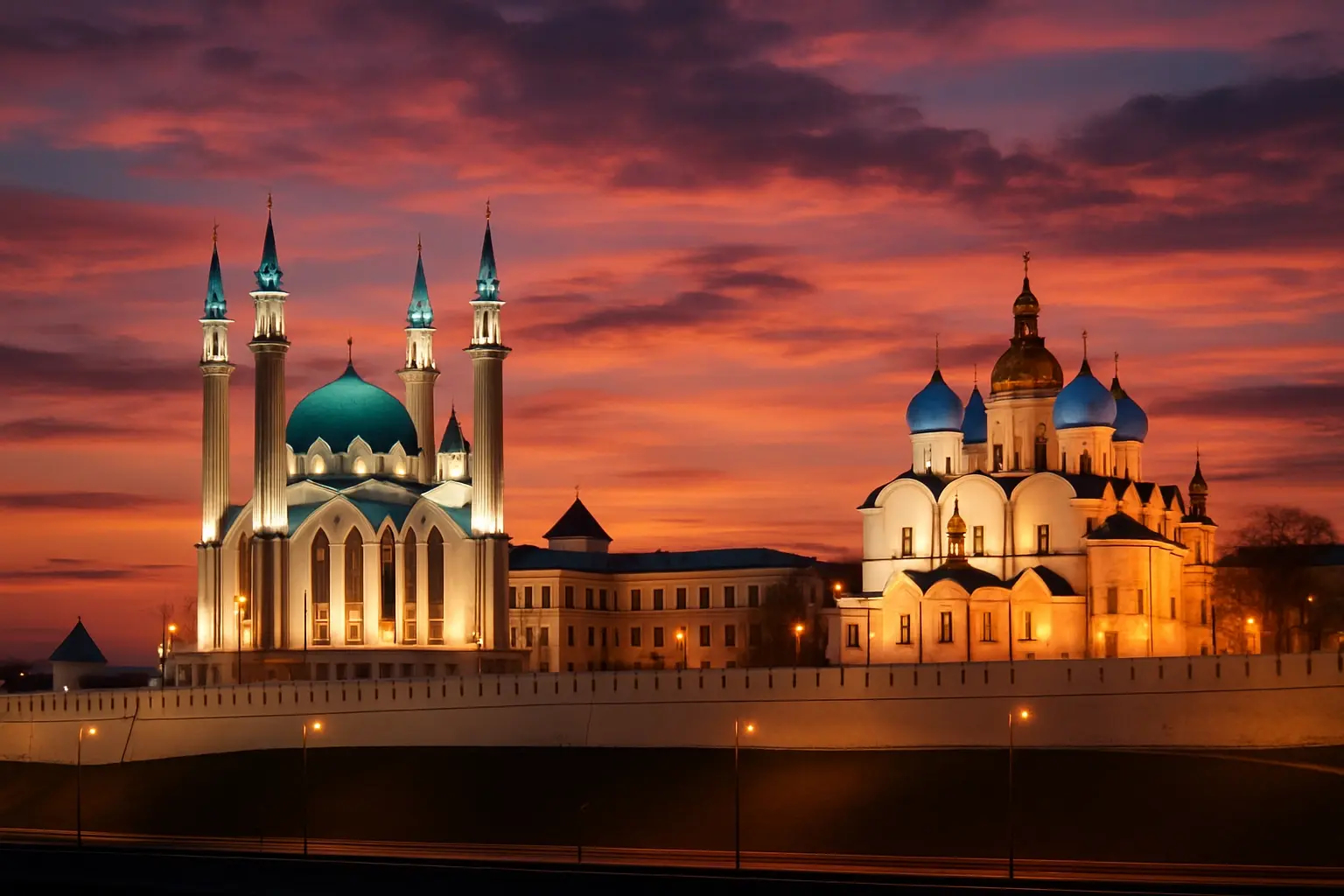
The Kazan Kremlin, a UNESCO World Heritage site, is the stunning embodiment of this cultural fusion. Unlike the Moscow Kremlin, which is a symbol of centralized state power, the Kazan Kremlin is a testament to tolerance and mutual respect. Within its white fortress walls stand two magnificent structures, side-by-side:
- The Annunciation Cathedral: A classic 16th-century Orthodox cathedral with beautiful blue and gold onion domes.
- The Kul Sharif Mosque (Мечеть Кул-Шариф): One of the largest mosques in Europe. The original mosque was destroyed by Ivan the Terrible during his conquest of Kazan in 1552. It was spectacularly rebuilt and reopened in 2005. With its soaring minarets and stunning blue-tiled dome, it is a masterpiece of modern Islamic architecture and a powerful symbol of the revival of Tatar identity.
The image of the cross and the crescent peacefully sharing the same skyline within the same fortress walls is a powerful symbol of Tatarstan’s unique identity.
The Temple of All Religions (Храм всех религий)
Just outside Kazan lies one of Russia’s most unique and eclectic architectural sites. The Temple of All Religions is the vision of a local artist, Ildar Khanov. It is not a functioning place of worship, but rather a cultural center and architectural symbol of religious unity. The fantastical structure combines the design elements of 16 different world faiths, including the dome of an Orthodox church, the minaret of a mosque, the Star of David from a synagogue, and elements of Buddhist pagodas. It is a vibrant, colorful, and deeply optimistic statement about the possibility of harmony.
Tatar Culture and Cuisine
The culture of Tatarstan is a unique blend, with its own language (Tatar), traditions, and delicious cuisine. Tatar food is influenced by Central Asian, Volga Bulgarian, and Russian cooking. A must-try local specialty is chak-chak (чак-чак), a celebratory dessert made from small pieces of fried dough drenched in hot honey, often formed into a mound or pyramid.
Conclusion: A Journey Through a Land of Contradictions
Our cultural exploration of Russia has taken us on a journey of immense scale and profound complexity. We began in Moscow, the seat of formidable power, and journeyed to St. Petersburg, the glittering showcase of imperial ambition. We crossed the endless forests of Siberia aboard the Trans-Siberian Railway and stood on the shores of Lake Baikal, a natural wonder of planetary importance. Finally, we ventured to the fiery, untamed wilderness of Kamchatka and the vibrant, multicultural crossroads of Kazan.
If this journey has shown us anything, it is that Russia is a land of deep and often jarring contradictions. It is a nation of exquisite artistic achievement and brutal history, of monolithic state power and fiercely independent regional cultures, of breathtaking natural beauty and harsh, unforgiving climates. It is European and Asian, Orthodox and Muslim, ancient and modern, all at once.
To understand Russia is to embrace these complexities. This exploration has been an attempt to look beyond the headlines and appreciate the deep layers of history, art, and nature that constitute this vast and endlessly fascinating country. It is a journey of the mind and of understanding, acknowledging that for the foreseeable future, the physical journey is one that must wait.


