


The Maldives is a destination of incredible nuance and geographical complexity. To do it justice, this comprehensive guide is presented as a multi-part series. Each section will build upon the last, guiding you from foundational knowledge to specific, detailed explorations of its most incredible atolls. We begin by understanding the very blueprint of this paradise.
The Blueprint of Paradise: Understanding Maldivian Geography and Travel
Before you can choose a destination within the Maldives, you must understand how the country is structured. This knowledge is the key to unlocking a trip that goes beyond the ordinary.
What is an Atoll? The Geological Miracle
The entire country of the Maldives is built upon atolls. An atoll is a ring-shaped coral reef, island, or series of islets. They are the product of a fascinating geological process first theorized by Charles Darwin. Millions of years ago, volcanoes rose from the ocean floor. Coral reefs began to grow around their shores. Over eons, these volcanoes slowly eroded and sank back into the sea, but the coral reefs continued to grow upwards towards the sunlight, leaving behind a ring of coral with a shallow, protected lagoon in the middle where the volcano once stood. Every island in the Maldives is part of one of these ancient, sunken volcanic mountain ranges.
One Nation, Two Worlds: Resort Islands vs. Local Islands
This is the single most important concept for any traveler to understand, as it defines your entire experience.
- Resort Islands: For decades, Maldivian tourism operated on a strict “one island, one resort” policy. This means that a private company leases an entire uninhabited island and develops it into a self-contained resort. On these islands, the resort’s rules apply: alcohol is served, dress codes (like bikinis) are permitted, and the experience is one of secluded luxury. The staff live on the island, but there is no local Maldivian community. This is the classic, postcard Maldivian experience.
- Local Islands (Inhabited Islands): The Maldives is a conservative Islamic nation. Until 2009, tourists were largely prohibited from staying on islands inhabited by local Maldivian communities. A change in law opened up these islands to tourism, creating a new and exciting way to experience the country. On local islands like Maafushi, Dhigurah, and Thulusdhoo, you stay in guesthouses run by local families, eat in local cafes, and share the beach with Maldivian residents. This offers a far more affordable and culturally immersive experience. However, it requires respect for local customs: alcohol is prohibited, and modest dress (covering shoulders and knees) is expected when walking through the village. Designated “bikini beaches” are usually available for tourists.
Choosing between a resort island and a local island is the first and most fundamental decision you will make.
North Malé Atoll: The Classic Gateway
The North Malé Atoll (also known as Kaafu Atoll) is the most visited and developed atoll in the Maldives, and for good reason. It is home to the Velana International Airport (MLE) and the nation’s capital, Malé, making it the gateway for virtually all visitors.
The Hub of Activity and Accessibility
The primary advantage of the North Malé Atoll is convenience. Upon arrival at the airport, your resort is just a short speedboat ride away, often taking only 20-40 minutes. This is a significant advantage over more remote atolls that require an additional, and often expensive, seaplane journey. This accessibility has made it the heart of Maldivian tourism for over 50 years.
A Spectrum of Luxury
Because it was the first atoll to be developed for tourism, North Malé offers the widest possible range of resort styles. You can find everything here:
- Historic Pioneers: The very first resorts in the Maldives, offering a more classic, rustic-luxe charm.
- Ultra-Luxury Icons: World-famous brands that define modern opulence, with sprawling water villas, celebrity chefs, and every conceivable amenity.
- Family-Friendly Resorts: Large resorts with excellent kids’ clubs, multiple swimming pools, and a wide array of activities.
- Surf Resorts: The eastern edge of the atoll is home to some of the country’s most famous surf breaks, with resorts catering specifically to the surfing community.
Malé: The World’s Most Unique Capital (A Deeper Dive)
Most tourists see Malé for only a few minutes from the window of their speedboat as they whisk past it on their way to a resort. To skip it entirely is to miss a fascinating and vital part of the Maldivian story.
Malé is one of the most densely populated cities on Earth. It is a vibrant, bustling, and colorful city packed onto a tiny island, a stark and fascinating contrast to the serene, empty islands of the resorts. A half-day tour of Malé offers a glimpse into the real, working heart of the nation.
Key Experiences in Malé:
- The Malé Fish Market: A sensory explosion. Witness the local fishermen unload their daily catch primarily tuna and expertly clean and portion it with incredible speed. It’s the bustling hub of the local economy.
- The Old Friday Mosque (Hukuru Miskiy): A UNESCO World Heritage site, this beautiful mosque was built in 1658. What makes it unique is that it is built not from stone, but from interlocking blocks of coral, intricately carved with Quranic script and elaborate patterns. It is a masterpiece of Maldivian craftsmanship.
- Sultan Park and the National Museum: Explore the green space of Sultan Park and visit the National Museum to understand the country’s pre-Islamic, Buddhist history and its journey as a sultanate.
- Respectful Exploration: When visiting Malé, it is essential to dress modestly out of respect for the local Islamic culture. This means covering your shoulders and knees. A visit here provides a crucial cultural context that enriches the rest of your Maldivian journey.
Exploring the North Malé Atoll offers more than just a convenient beach vacation; it provides a chance to see both the polished face of Maldivian tourism and the authentic, beating heart of its unique urban culture.
Read Also: Top Destinations in England: Beyond the Obvious
Baa Atoll: A UNESCO Biosphere Reserve
Located northwest of the Malé atoll, Baa Atoll is not just another collection of beautiful islands and luxury resorts. It is a place of global ecological importance, officially designated as a UNESCO Biosphere Reserve. This designation recognizes the atoll’s unique harmony between its rich biodiversity and its human inhabitants, with a strong focus on conservation and sustainable development. The resorts here often reflect this ethos, many with a deep commitment to sustainability and marine biology education.
Hanifaru Bay: The World’s Largest Manta Ray Feeding Station
At the heart of Baa Atoll’s ecological significance is a small, seemingly unremarkable bay called Hanifaru Bay. For most of the year, it is a quiet, uninhabited inlet. But for a few months each year, it becomes the stage for one of the most spectacular underwater phenomena on Earth.
The Phenomenon: A Plankton Super-Soirée
During the southwest monsoon season (typically from May to November), a unique combination of lunar tides and ocean currents funnels a massive concentration of plankton into the bay’s narrow, cul-de-sac-like geography. This plankton soup becomes an irresistible, all-you-can-eat buffet for the ocean’s great filter feeders.
The Great Gathering
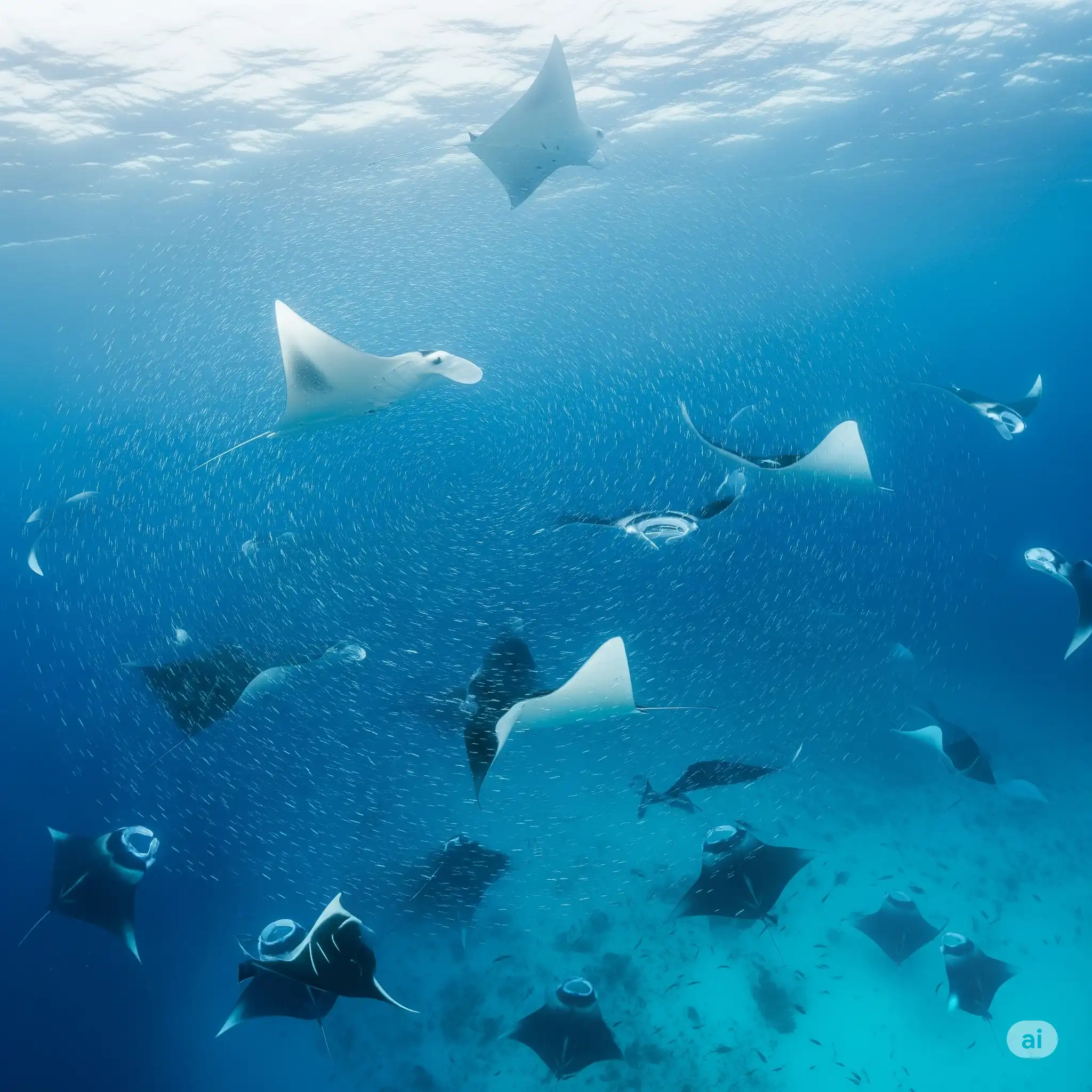
The result of this plankton bloom is the arrival of an astonishing number of reef manta rays (Manta alfredi). On a peak day, it is possible to witness over 100 individuals in this small bay, often accompanied by several whale sharks, feeding on the rich broth. They engage in incredible feeding behaviors, most notably “cyclone feeding,” where a chain of dozens of mantas will swim in a spiraling vortex, creating a whirlpool that concentrates the plankton for even easier consumption. It is a breathtaking underwater ballet of immense, graceful creatures.
A Strictly Regulated Sanctuary: Snorkeling Only
This is a critical point for any visitor to understand. To protect this fragile environment and the animals, Hanifaru Bay is a Marine Protected Area (MPA) with very strict regulations.
- SCUBA DIVING IS STRICTLY FORBIDDEN in the bay. Encounters are limited to snorkeling only. This is to prevent bubbles and equipment from disturbing the animals’ natural feeding patterns.
- All visits are managed by licensed guides and park rangers. There are limits on the number of boats and people allowed in the bay at any one time, and strict time limits for each visit.
- A code of conduct is enforced, requiring snorkelers to maintain a respectful distance and not to chase or touch the animals.
This responsible approach ensures that the phenomenon can continue and that visitors can witness it in the most natural way possible.
South Ari Atoll: The Whale Shark Superhighway
While Baa Atoll is famous for its seasonal manta spectacle, our next destination, the South Ari Atoll, is renowned for its year-round consistency in delivering encounters with the largest fish in the ocean.
A Year-Round Haven for Gentle Giants
The whale shark (Rhincodon typus) is a slow-moving, filter-feeding shark and the world’s largest living nonmammalian vertebrate. Despite their immense size they can grow up to 60 feet (18 meters) long they are completely harmless to humans. The deep channels and nutrient-rich currents along the outer reef of the South Ari Atoll have created a perfect environment, making it one of the very few places on Earth where these gentle giants can be spotted all year round.
The South Ari Marine Protected Area (SAMPA)
The entire southern fringe of the atoll is a designated Marine Protected Area, a recognition of its importance as a crucial habitat for whale sharks. Local tour operators and resorts work in conjunction with spotters and researchers to locate the sharks. The process typically involves cruising along the reef edge until a shark, often swimming just below the surface, is spotted. Snorkelers are then dropped into the water ahead of the shark’s path for a chance to swim alongside it.
Responsible Encounters: The Code of Conduct
The privilege of swimming with these magnificent creatures comes with a great responsibility. The Maldives Whale Shark Research Programme (MWSRP), a conservation charity, has worked extensively with local communities and tour operators to establish a strict code of conduct for encounters. Key rules include:
- No Touching: Never attempt to touch, ride, or chase a whale shark.
- Keep Your Distance: Stay at least 3 meters (10 feet) from the head and 4 meters (13 feet) from the tail.
- No Flash Photography: The flash can startle the animals.
- Give Them Space: Do not block the shark’s path. Approach from the side and give it a clear path to swim away.
Following these rules is essential for a sustainable and ethical tourism experience that protects these incredible animals.
World-Class Diving: Thilas and Channels
Beyond the whale sharks, South Ari Atoll is also a legendary destination for scuba divers. The atoll is famous for its thilas submerged coral pinnacles that rise from the atoll floor and act as cleaning stations and magnets for marine life. Dives at famous sites like Kudarah Thila or Maamigili Beyru can reward divers with sightings of reef sharks, turtles, eagle rays, and vast schools of colorful fish.

The Southern Atolls: Beyond the Tourist Trail
For travelers seeking true seclusion and a glimpse into a different side of Maldivian life and history, the southern atolls offer a compelling escape. Reaching them requires a domestic flight from Malé, but the reward is fewer crowds, pristine reefs, and a unique local character.
Addu Atoll: Crossing the Equator
Addu is the southernmost atoll in the Maldives and, along with Fuvahmulah, the only one that lies in the Southern Hemisphere. Crossing the equator to get here is a unique geographical milestone for any traveler.
A Unique Geography
Unlike the classic ring shape of many northern atolls, Addu has a more complex, almost heart-shaped geography. Uniquely, several of the islands on its western side Gan, Feydhoo, Maradhoo, and Hithadhoo are connected by a 10-mile (16-kilometer) causeway. This creates a landscape unlike anywhere else in the country, allowing visitors to rent a bicycle and explore multiple islands, villages, and communities in a single day, a stark contrast to the isolated “one island, one resort” model.
The British Legacy
Addu has a fascinating and unique 20th-century history. From 1957 to 1976, the island of Gan was home to a major British Royal Air Force base, RAF Gan. This long period of British presence left a lasting legacy. English is more widely spoken here, the atoll has a more cosmopolitan feel, and the infrastructure, including the causeway and the large Gan International Airport, is a remnant of this era. The barracks and other buildings from the RAF base have been repurposed into hotels and local facilities.
A Different Ecosystem
The atoll’s proximity to the equator gives it a slightly different climate and ecosystem. The islands feel lusher and more tropical, there are small freshwater lakes (a rarity in the Maldives), and it’s a haven for birdlife, including the beautiful white terns that are not commonly found further north.

The Guesthouse Revolution: Experiencing the “Real” Maldives
As we explained in Part One, the Maldives is no longer exclusively the domain of ultra-luxury resorts. Since 2009, tourism on inhabited local islands has flourished, creating what is known as the “guesthouse experience.” This offers travelers a chance to experience the same breathtaking natural beauty as the resorts the same white sand, turquoise water, and incredible marine life at a fraction of the cost, all while directly supporting local communities.
Maafushi: The Bustling Guesthouse Hub
Located in the South Malé Atoll, Maafushi is the pioneer and the most developed of the local tourist islands. It is a fantastic entry point into the world of budget-friendly Maldivian travel.
- The Pros: Maafushi offers the widest variety of affordable guesthouses, from simple rooms to more boutique-style inns. The island is packed with local restaurants, cafes, and, most importantly, numerous tour operators who offer the exact same excursions you would find at a resort snorkeling trips, sandbank visits, dolphin watching cruises, and resort day-passes for a much lower price.
- The Cons: It is crucial to set the right expectations. Maafushi is not a secluded, quiet escape. It is a busy, bustling hub. Its designated “Bikini Beach” (the area where tourists are permitted to wear bikinis) can get crowded. It is the perfect choice for social travelers, backpackers, and anyone looking for an active, affordable base for exploration.
Dhigurah: The Whale Shark Island
For an experience that blends the local island vibe with a world-class natural attraction, Dhigurah is an unbeatable choice.
- Location, Location, Location: As we learned in Part Two, Dhigurah is located in the heart of the South Ari Atoll Marine Protected Area (SAMPA), the year-round superhighway for whale sharks.
- The Experience: The island itself is long and narrow, ending in a spectacular, tapering sandbank. You stay in a friendly local guesthouse and eat at local cafes. Each day, you can join a tour run by experienced local guides who are experts at finding the gentle giants. This offers a more rustic, integrated, and arguably more authentic way to experience these magnificent creatures compared to a large-scale resort excursion. It is a perfect example of a local community building a sustainable tourism model around its unique natural assets.
The Rules of Respect: Local Island Etiquette
The privilege of experiencing the authentic Maldives comes with the responsibility of respecting its culture. The Maldives is an Islamic nation, and the following rules of etiquette are essential when visiting any inhabited local island:
- Modest Dress: When walking through the village areas (anywhere outside your guesthouse or the designated tourist beach), both men and women should dress modestly. This means covering your shoulders and knees. A t-shirt and shorts or a sarong are perfect.
- Bikini Beaches: Swimwear like bikinis and speedos should only be worn on the designated “Bikini Beach.” These are clearly marked areas set aside for tourists. Do not walk through the village in your swimwear.
- Alcohol is Prohibited: It is illegal to bring, sell, or consume alcohol on any local island. Guesthouses do not serve it. Do not attempt to bring it from the airport.
- Respect Religious Customs: Be mindful of the local culture. Mosques will issue the call to prayer five times a day. During the holy month of Ramadan, be considerate as many locals will be fasting during the day.
- Public Displays of Affection: These should be kept to a minimum out of respect for local customs.
Adhering to these simple rules ensures a positive and respectful interaction with the warm and welcoming Maldivian communities.
When to Go: Navigating the Maldivian Monsoons
The Maldives has a tropical climate that is beautiful year-round, but it is dictated by two distinct monsoon seasons. Understanding them is key to planning a trip that aligns with your priorities, whether they be perfect weather or spectacular marine encounters.
The Dry Season (Northeast Monsoon / Iruvai): December to April
This is the peak season and what most people imagine when they think of the Maldives.
- Characteristics: Expect blue skies, minimal rainfall, lower humidity, and calm seas. Water visibility is at its absolute best, making it fantastic for scuba diving and snorkeling.
- Considerations: This is the most popular and therefore the most expensive time to visit. Resorts and flights are priced at their highest, and you will need to book well in advance.
The Wet Season (Southwest Monsoon / Hulhangu): May to November
This is the low season, but it holds its own powerful secrets.
- Characteristics: The weather is less predictable. There is a higher chance of rainfall, but it often comes in short, intense bursts, frequently followed by hours of sunshine. The seas can be choppier and the humidity is higher.
- The Marine Megafauna Secret: This is the crucial, lesser-known advantage. The shift in ocean currents during this season creates a massive concentration of plankton in certain areas. This makes the wet season the absolute best time for marine megafauna encounters. The great manta ray gathering at Hanifaru Bay (as discussed in Part Two) happens exclusively during these months. Whale shark sightings are also at their peak. For serious marine life enthusiasts, this is the prime time to visit. Prices for resorts and flights are significantly lower.
The Crucial Logistics: Getting to Your Island
In the Maldives, getting from the international airport (MLE) to your final destination is an integral part of the adventure. The method of transfer is determined by your island’s distance from Malé.
The Three Modes of Transfer
- Speedboat: This is the standard transfer method for resorts and local islands located in the atolls closest to the airport, primarily the North and South Malé Atolls.
- Pros: It is the most affordable transfer option and can operate 24/7, making it convenient for late-night flight arrivals.
- Cons: The ride can be bumpy, especially if the seas are rough.
- Seaplane: For atolls further afield (like Baa, South Ari, Lhaviyani), the seaplane is the iconic Maldivian experience.
- Pros: It is far more than just a transfer; it is a spectacular scenic flight. The views of the atolls from above the perfect coral rings, the tiny islands, the shifting shades of blue are utterly unforgettable.
- Cons: Seaplanes are expensive. They also operate only during daylight hours (roughly 6 AM to 4 PM). If your international flight arrives late in the evening or departs early in the morning, you will need to arrange an overnight stay in a hotel near the airport. They also have strict luggage limits.
- Domestic Flight + Speedboat: For the most remote atolls in the far north or far south (like Addu), the journey involves a standard domestic flight from Malé to a regional airport, followed by a short speedboat ride to your island. This allows access to the furthest corners of the country.
Choosing Your Paradise: A Guide to Accommodation
With over 1,000 resorts and guesthouses, choosing the right one can be daunting. Here’s how to narrow it down based on your travel style.
- For the Ultimate Luxury Seeker (Resorts):
- Overwater vs. Beach Villa: The classic choice. Overwater offers direct lagoon access; beach villas offer privacy and your own stretch of sand.
- House Reef: If you are an avid snorkeler, choose a resort with a good “house reef” a coral reef accessible directly from the beach, allowing you to snorkel whenever you please.
- All-Inclusive Plans: Consider an all-inclusive plan to manage costs, as à la carte food and drink prices at resorts can be extremely high.
- For the Cultural and Budget-Conscious Traveler (Guesthouses):
- Choose your local island based on your primary interest. As we learned in Part Three, this could be Dhigurah for whale sharks, a surf-focused island like Thulusdhoo, or a bustling hub like Maafushi for a wide variety of affordable excursions.
Crafting Your Perfect Itinerary: Sample Journeys in the Atolls
Let’s tie it all together with some sample itineraries.
The 5-Day “Classic Luxury Escape” (Honeymooners / First-Timers)
- Focus: Relaxation, romance, and the iconic Maldivian luxury experience.
- When to Go: Dry Season (December – April).
- Itinerary: Arrive at Malé (MLE), take a pre-arranged speedboat to a luxury resort in the North or South Malé Atoll. Spend your days switching between your overwater villa’s private deck, the resort’s infinity pool, and the white sand beach. Indulge in a spa treatment and enjoy a sunset dolphin cruise.
The 7-Day “Marine Biologist’s Dream”
- Focus: Maximizing encounters with world-class marine megafauna.
- When to Go: Wet Season (July – October).
- Itinerary: Arrive at Malé, take a seaplane to a resort or guesthouse in the Baa Atoll. Dedicate your days to guided snorkeling trips in Hanifaru Bay to witness the manta ray aggregation. Alternatively, choose a resort or local island (like Dhigurah) in the South Ari Atoll for consistent whale shark and manta sightings.
The 10-Day “Affordable Atoll Hopper”
- Focus: Experiencing the beauty and culture of the Maldives on a budget.
- When to Go: Shoulder Season (April/May or October/November).
- Itinerary: Arrive at Malé, take the local ferry to Maafushi (4 days). Use it as a vibrant and social base for affordable excursions: snorkeling at nearby reefs, a sandbank picnic, and a fishing trip. Arrange a speedboat transfer to the quieter island of Dhigurah (5 days) to experience the local whale shark tours and relax on its magnificent sandbank. Return to Malé for your flight home.
An Explorer’s Epilogue: The Fragile Universe
Our journey through the Maldivian universe, from its bustling capital to its silent, deep-water channels, has revealed a nation of profound beauty and surprising complexity. We have seen that beyond the iconic overwater villa lies a world of unique culture, staggering natural phenomena, and a deep, abiding connection to the ocean.
To visit the Maldives is to witness a nation that is, in every sense, a product of the sea. But this intimate relationship is also one of immense vulnerability. As the world’s lowest-lying country, the Maldives is on the front line of the climate crisis, facing the existential threat of rising sea levels.
Therefore, a journey to these islands in the 21st century is more than just a luxury escape; it is a visit to a precious and fragile ecosystem. It is an opportunity to support a nation that is a global leader in marine conservation and a powerful voice for climate action. To travel here thoughtfully by respecting its culture, supporting sustainable operators, and appreciating the delicate balance of its natural world is to not only create memories that will last a lifetime but also to become a witness to a place of unparalleled beauty that we must all work to protect.


